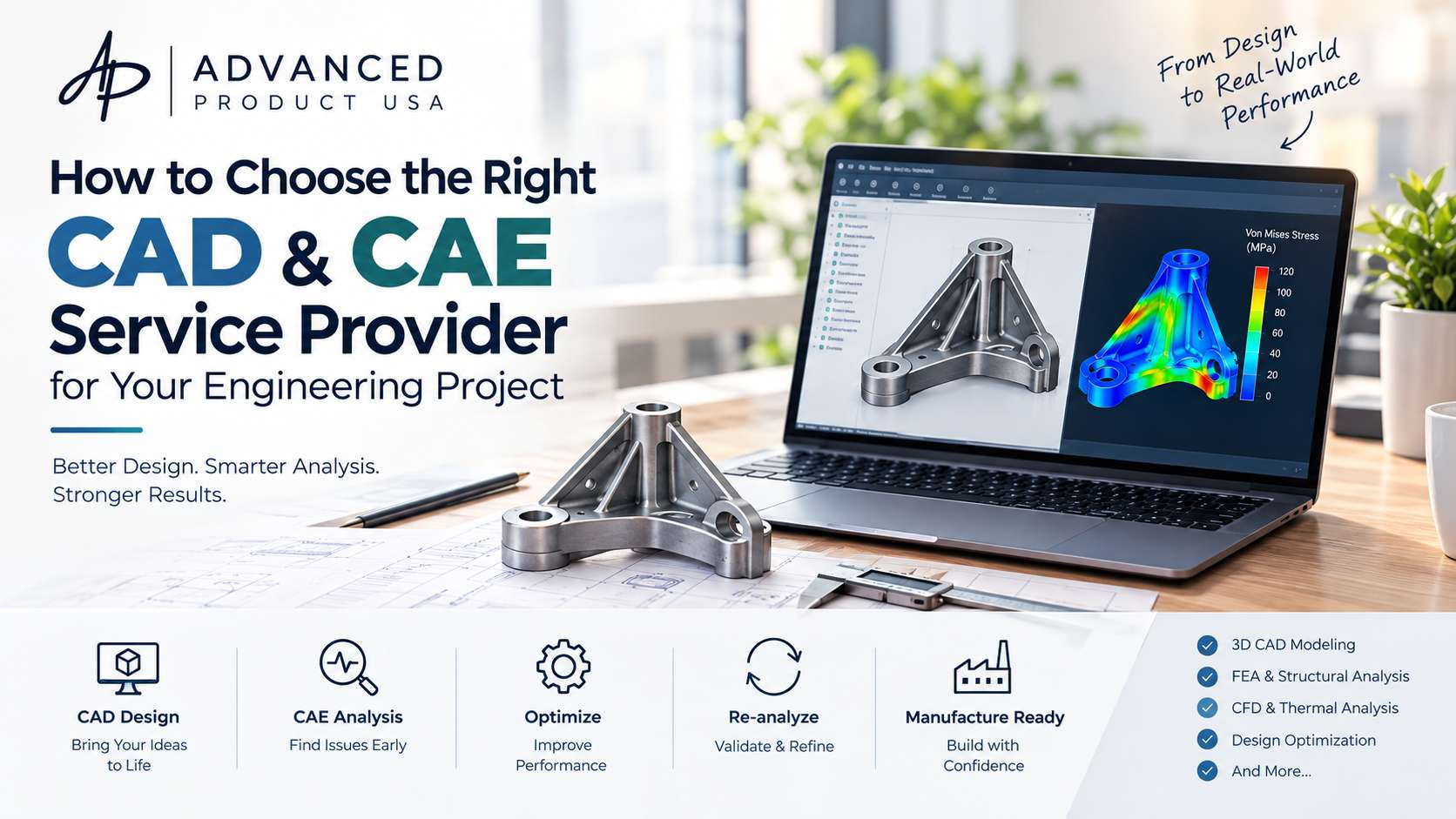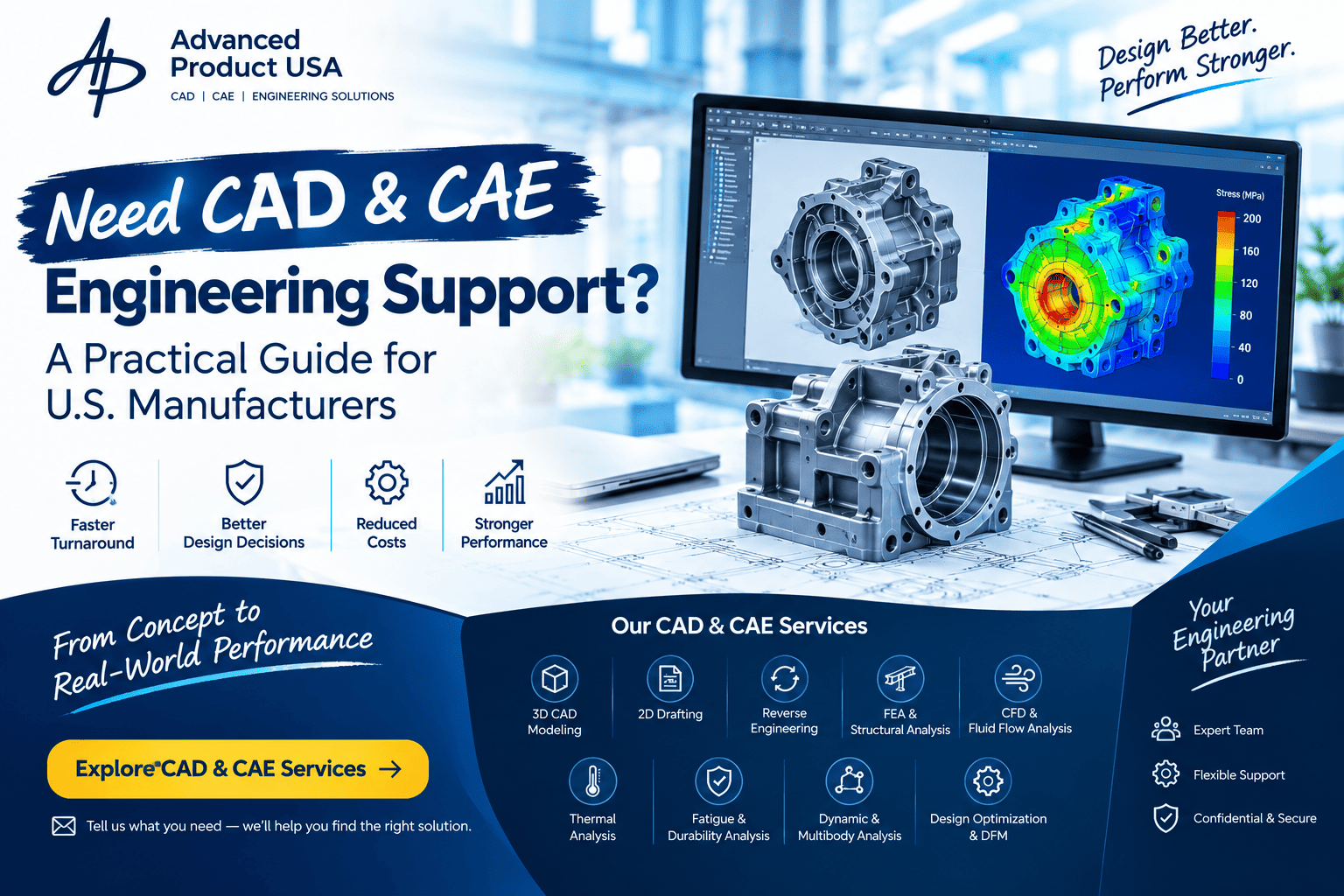
CAD and CAE solve different parts of the engineering problem.
CAD — Computer-Aided Design — is used to create, modify, document, and communicate product designs. This can include engineering drawings, 3D models, assemblies, design changes, and related documentation.
CAE — Computer-Aided Engineering — is used to analyze or simulate defined engineering conditions. Depending on the project, this may include FEA, CFD, structural analysis, fluid-flow analysis, or other engineering simulations.
Think of it this way:
CAD helps you build the digital design.
CAE helps you understand how that design may perform.
And sometimes, you need both.
For example, a product team may first need a 3D CAD model, then need FEA to evaluate a structural question, then revise the model based on the engineering findings.
That is why choosing between CAD and CAE should start with the problem you need solved, not simply the software you want someone to use.
You may be considering CAD outsourcing because your internal team is simply running out of time.
Maybe the work is straightforward, but it keeps getting pushed down the priority list.
Maybe you have an existing design that needs to be converted into proper engineering drawings.
Or perhaps a customer has requested a design modification that your engineers cannot get to this week.
These are situations where external CAD support can make sense.
Your engineers are spending too much time on drafting
Engineers should not have to spend all of their time managing repetitive drawing updates when more important design or manufacturing decisions are waiting. Outsourcing a defined drafting workload can allow your internal team to focus on engineering decisions while the assigned CAD work moves forward.
You need a 3D model from existing information
You may already have sketches, drawings, measurements, photographs, or an older CAD file. The problem is turning those references into a usable digital model. That is where 3D CAD modeling or CAD conversion support may be appropriate.
Your drawings keep changing
Design changes are normal. The problem starts when revisions become difficult to track. An outdated drawing reaching the wrong person can create unnecessary confusion between engineering, purchasing, production, quality, and suppliers. ASME Y14.35 specifically addresses practices for revising engineering drawings and associated documents, including identifying and recording revisions. Your CAD workflow should therefore make it clear which files are current and what has changed.
You need extra capacity for a specific project
You may have enough engineering resources for your normal workload but not for a large new project. That does not necessarily mean you need another permanent employee. For a defined project, outsourced CAD support can provide additional capacity while your internal team remains involved in technical decisions and approvals.
This is an important distinction. If the question is:
You are probably looking at a CAD requirement. If the question is:
You may need CAE.
FEA: when you need to evaluate structural behavior
FEA, or Finite Element Analysis, can be used to investigate defined structural or mechanical questions. Depending on the project, you may want to understand stress, deformation, or structural response under specified loads and constraints. But FEA is not simply a button you press on a CAD model. The quality of the result depends on the engineering problem, model assumptions, material information, boundary conditions, loads, mesh strategy, and interpretation. That is why a good FEA project starts with a clear engineering question.
CFD: when the problem involves fluid flow
CFD, or Computational Fluid Dynamics, is used for computational analysis of fluid-flow-related problems. Depending on the application, a project may investigate pressure, velocity, temperature, flow behavior, or other defined variables. Again, the important question is not simply "Do I need CFD?" It is: "What engineering question do I need the simulation to answer?" That answer helps determine the appropriate inputs, model scope, and expected deliverables.
This is where the two services can work together.
Imagine your company is developing a new mechanical component. You first need the component modeled in 3D. That is CAD. Then you need to evaluate how the design behaves under a defined loading condition. That is CAE/FEA. The analysis identifies an area that needs modification. The CAD model is updated. The analysis may then need to be reviewed again.
That creates a practical engineering workflow:
For companies developing physical products, having access to both CAD and CAE support can make it easier to manage projects that move between design and engineering analysis.
The right service depends on what is actually holding your project back.
For CAD work, you may need:
2D CAD drafting
3D CAD modeling
Assembly modeling
CAD conversion
Reverse engineering
Drawing updates
Design modifications
For CAE work, depending on your actual project requirements, you may need:
FEA
CFD
Structural analysis
Fluid-flow analysis
Another defined engineering analysis
You do not necessarily need to outsource the entire engineering project.
Sometimes the smarter approach is to outsource one clearly defined part of the workload:
A drawing package
A group of 3D models
A reverse-engineering assignment
A defined FEA or CFD analysis
The more clearly that scope is defined, the easier it becomes to discuss timelines, deliverables, and pricing.
There is no single CAD outsourcing cost that applies to every project.
A simple drawing update is not comparable to a complex assembly containing dozens of components. Likewise, an FEA project requiring detailed engineering inputs is very different from basic 3D modeling.
Your actual project cost can depend on:
Complexity of the geometry
Quality of reference files
Number of parts or drawings
Required deliverables
Software and file formats
Analysis requirements
Revision cycles
Timeline
This is why comparing providers based only on a headline hourly rate can be misleading. Instead, compare what you are actually receiving. Ask:
What is included?
What files will I receive?
How many revisions are included?
What information does the provider need from me?
What happens if the project scope changes?
A project-specific quote gives you a much clearer basis for making that decision.
You do not need a perfect engineering brief to contact a service provider. Start with the information you already have.
Tell the provider what you are trying to accomplish. Then share the available drawings, CAD files, sketches, measurements, reference images, or other relevant project information.
If you need CAD, explain whether you need drafting, 3D modeling, conversion, reverse engineering, or another specific task.
If you need CAE, explain the engineering question you want to investigate.
For FEA: available material information, loading conditions, constraints, and the result you need to understand.
For CFD: the fluid, operating conditions, geometry, boundary conditions, and the performance question being investigated.
You may not have every detail finalized. That is okay. Tell the provider what is known, what is missing, and what you are trying to achieve. That gives the engineering team something useful to work with.
Price matters, but it should not be the only thing you compare.
Technical fit: Can the provider handle the type of CAD or CAE work your project requires?
Deliverables: Will you receive the file formats your team actually needs?
Communication: Who will answer technical questions? Who will review the work? How will revisions be handled?
Commercial scope: A good quote should tell you what is included rather than leaving important details open to interpretation.
For CAD projects, clarify drawing standards, tolerances, revision requirements, and file compatibility. ASME Y14.5 is an important reference for geometric dimensioning and tolerancing, including the communication of design intent through engineering drawings and digital product-definition data.
Your project does not always need a large engineering engagement. Sometimes you need one drawing package completed. Sometimes you need 3D CAD support. Sometimes the problem is more technical and requires FEA or CFD. And sometimes you need both CAD and CAE support as the project develops.
Advanced Product USA provides CAD and CAE engineering support for businesses that need additional project capacity or technical assistance.
The starting point is simple:
Tell us what you are trying to accomplish.
Tell us what information you already have.
Tell us what you need delivered.
From there, the project requirements can be discussed and a suitable quote can be prepared.
Don't let unfinished engineering work become the reason your next project milestone gets pushed back. Whether you need CAD drafting, 3D modeling, reverse engineering, FEA, CFD, or combined CAD + CAE support, start with your actual project requirement.
Or contact Advanced Product USA: Phone: +1 888-418-4183 · Email: customercare@advancedproductusa.com
What is the difference between CAD and CAE?
CAD is used to create and modify digital designs, models, assemblies, and engineering drawings. CAE is used to analyze defined engineering questions through methods such as FEA or CFD.
What CAD services can I outsource?
Depending on project requirements, businesses may outsource 2D CAD drafting, 3D CAD modeling, assembly modeling, CAD conversion, reverse engineering, drawing updates, and design modifications.
What CAE services can I outsource?
Depending on the provider's capabilities and project scope, CAE outsourcing may include FEA, CFD, structural analysis, fluid-flow analysis, and other defined engineering simulation work.
When should I use FEA?
FEA may be appropriate when you need to investigate a defined structural or mechanical engineering question, such as stress or deformation under specified conditions. The appropriate inputs, assumptions, boundary conditions, and validation approach should be established for the project.
When should I use CFD?
CFD may be appropriate when you need to investigate a defined fluid-flow-related engineering question. The analysis requirements depend on the geometry, fluid, operating conditions, boundary conditions, and desired results.
Can I outsource both CAD and CAE?
Yes. A project may use CAD to create or modify the design and CAE to evaluate a defined engineering performance question. The two can form part of the same development workflow.
How much does CAD outsourcing cost?
Cost varies according to project complexity, source information, required deliverables, file formats, revisions, timeline, and other project requirements. A project-specific quote is more useful than a generic price estimate.
What do I need to request a CAD/CAE quote?
Start with your project description, available drawings or CAD files, required service, expected deliverables, file formats, timeline, and relevant engineering information. If something is not finalized, explain what is still being determined.
How do I request CAD/CAE services from Advanced Product USA?
Visit the Advanced Product USA CAD & CAE services page and submit your project requirements for discussion and a quote.
Ready to move your engineering project forward? CAD. CAE. FEA. CFD. One project requirement at a time.

Located in the industrial area of Vadodara, Gujarat, India, our company is staffed with highly professional teams dedicated to delivering world-class products tailored to customer requirements.
1500 Chestnut St. Suite 2, Philadelphia, PA, 19102, United States
+1 888-418-4183
G.I.D.C., Makarpura Vadodara - 390010, Gujarat, India.
Bamangam, Vadodara-Karjan Highway, Vadodara - 390010, Gujarat, India.
© 2026 Advanced Product LLC. All rights reserved.